Village TMS provides ketamine therapy in Manhattan from a single...
Read More
When patients ask what makes a great ketamine clinic in NYC, the honest answer is not the price, the brand, or the décor of the treatment room. The best ketamine therapy in NYC consistently produce good outcomes share a small number of specific traits: a board-certified psychiatrist supervising sessions in person, transparent pricing without hidden fees, proper pre-treatment screening, and integration therapy built into the program. The rest is mostly noise. The eight signs below are what to actually look for, and the red flags that should make you pause before booking anywhere.
If you searched for the best ketamine therapy in NYC, you have already seen the listicles and the ranked directories. Most of them are paid placements, review-count aggregators, or marketing exercises. None of those signals correlate with clinical quality, and the clinics that consistently produce good outcomes are not always the ones that show up at the top of a sponsored list.
There is no single best ketamine clinic in NYC because outcomes vary too much patient-to-patient for a blanket ranking to mean anything. The patient with treatment-resistant depression and complex psychiatric history needs a different setup than the patient seeking maintenance dosing for chronic anxiety. The clinic that fits one will not always fit the other.
What you can evaluate is whether a clinic has the infrastructure, supervision, and protocols that produce good outcomes regardless of who walks through the door. The criteria below are what to look for. They apply equally to any ketamine provider in Manhattan, the outer boroughs, or the suburbs, and they are the same questions clinicians use when they refer patients to one another.
The criteria below are what actually matter, in roughly the order they affect outcomes. Use them to evaluate any clinic, including ours.
This is the criterion with the largest single impact on outcomes, and the one that separates the best ketamine therapy in NYC from the rest of the market. Many ketamine clinics in New York are owned and operated by anesthesiologists or emergency medicine physicians, and many use rotating nurse practitioners or technicians for in-session monitoring. That model works for procedural sedation. It works less well for treating mental health conditions, where the clinical decision-making during a session is psychiatric, not procedural.
The questions a psychiatrist is trained to ask during a ketamine session are different from the questions an anesthesiologist asks. Is this dissociation therapeutic or distressing? Is this patient’s current presentation suggesting bipolar features that should change our approach? Are we seeing the kind of insight that integration therapy can build on, or the kind that needs careful handling?
When you call a clinic, ask who is physically in the room during your sessions. Ask whether that person is a psychiatrist, by name, with a verifiable license. If the answer is vague, or if you are told that medical oversight is provided remotely, that is a meaningful signal.
The per-session price a clinic quotes you should be the price you actually pay. In practice, many NYC clinics quote a low headline number and then add separate charges for psychiatric evaluation, lab work, integration therapy, and follow-up appointments. By the end of a six-session induction course, the total can be 30 to 50 percent higher than the headline price suggested. Ask any clinic for a complete cost estimate before you book, including all evaluations, follow-ups, and integration sessions. A clinic that cannot give you a clear total before treatment is signaling something. We covered this in detail in our guide to ketamine therapy costs in NYC.
A reputable ketamine clinic will not book your first infusion until a clinician has reviewed your full medical history, current medications, prior psychiatric treatment, and any cardiovascular or substance use considerations. This is not bureaucracy. It is the difference between safe treatment and an avoidable adverse event.
The specific things that should be screened before any ketamine is administered are bipolar disorder (where ketamine carries a small risk of mood switching), psychosis or psychotic features, active substance use, uncontrolled hypertension or cardiac arrhythmias, and certain medications that can blunt or amplify ketamine’s effects. A clinic that schedules your infusion before having this information has skipped the most important part of the process.
If a clinic offers to book you for a same-day or next-day first infusion without a full clinical consultation, walk away.
The drug ketamine clears your system in hours. The therapeutic window where neuroplasticity is highest, and where the brain is most open to forming new patterns, lasts days. What you do in that window is what determines whether your response holds for weeks or months. Integration therapy, particularly approaches like ketamine-assisted therapy, is how clinics turn a chemical effect into lasting change. A clinic that treats ketamine as a stand-alone procedure, with no integration component and no referral to a therapist who understands the work, is leaving the most valuable part of the treatment on the table.
Ask any clinic how they support patients between and after sessions. The answer should be specific: who provides integration therapy, whether it is in-house or referred, and how soon after each session those conversations happen.
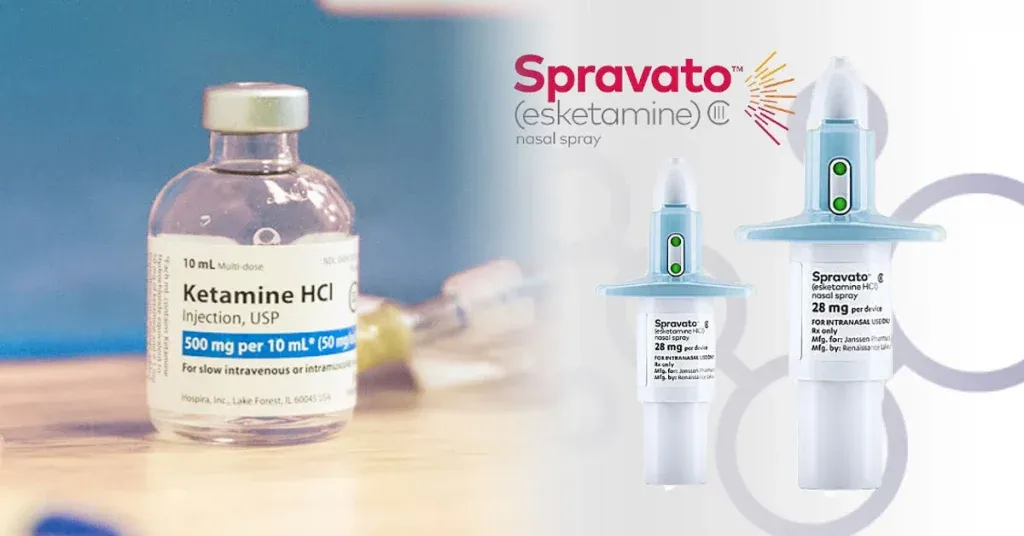
There are three primary delivery formats for ketamine therapy: IV infusion, intramuscular (IM) injection, and FDA-approved Spravato (esketamine) nasal spray. Each has a different clinical profile, cost structure, and insurance situation. A patient with severe treatment-resistant depression and good insurance often does best on Spravato. A patient with complex symptoms and a flexible budget may benefit from IV. A patient who needs maintenance dosing alongside structured therapy often prefers IM. Single-format clinics push every patient toward the format they happen to offer, which is rarely the right answer for everyone.
A clinic that offers all three formats can match the treatment to your situation, your insurance, and your response history. Spravato, in particular, is often covered by major insurers, including United Healthcare and Blue Shield, which makes it the most accessible option for many patients. You can read more on our Spravato page.
During an IV ketamine session, your heart rate, blood pressure, and clinical status should be monitored continuously by a clinician. This is not optional. Ketamine produces transient blood pressure increases and dissociative effects that occasionally need real-time management. A clinic that leaves you alone in a room for the duration of a 40-minute infusion is not delivering the standard of care.
When you visit a clinic for an initial consultation, ask what monitoring looks like during the session itself. The answer should describe a clinician’s physical presence, vital sign monitoring, and the ability to adjust the infusion rate if needed. If the answer is a call button and an empty chair, look elsewhere.
Quality clinics talk about ketamine the same way good clinical literature does. Some patients respond dramatically. Some respond moderately. Some do not respond at all. The clinical evidence is strong for treatment-resistant depression, growing for PTSD and OCD, and more limited for other indications. The duration of response varies widely between patients and tends to require maintenance dosing. We covered this in our article on how long ketamine’s effects last for depression.
Be skeptical of any clinic that describes ketamine as a “miracle cure,” promises specific outcomes, or markets dramatic before-and-after results without clinical context. Legitimate providers talk about response rates, individual variation, and the work of staying well. Marketing language that sounds too good to be true usually is.
The induction course is not the whole story. Most patients who respond well to ketamine therapy benefit from periodic maintenance infusions to sustain their response, scheduled every four to eight weeks based on how their symptoms track. A good clinic will discuss this with you before you start, set realistic expectations, and have a clear plan for follow-up.
If a clinic markets ketamine as a one-time fix, or if maintenance is presented as an upsell rather than a clinical recommendation, that is worth questioning. Ask how the clinic decides when a patient is ready to space out sessions, and how decisions about long-term care get made.
Beyond what to look for, a few specific patterns should make you stop and ask harder questions before booking:
If you are evaluating two or three NYC ketamine clinics, the fastest way to compare them is to walk into each consultation with the same set of questions. The answers will sort the clinics quickly, and the way each provider responds tells you as much as the answers themselves.
That last question is the one that separates clinics that view ketamine as one tool among several from clinics that view it as the answer to every patient who walks in. The right answer is rarely “ketamine for everyone.”
We have made the case throughout this guide that no one clinic is objectively the best ketamine therapy NYC has to offer. What we can say is where Village TMS sits against the criteria above. Sessions are supervised in person by Dr. Yuli Fradkin, MD, a psychiatrist with more than 25 years of experience and academic appointments at Beth Israel, Tufts, Yale Medical School, and Rutgers University. The team also includes Dr. Elena Bruck, MD, who brings nearly twenty years of clinical practice in Vienna and New York and offers care in English, Russian, and German.
We offer all three primary formats (IV, IM, and Spravato) in our Manhattan office, with continuous monitoring throughout every session, transparent published pricing, and integration therapy as a built-in part of the program. Pre-treatment screening is non-negotiable: we review your full medical and psychiatric history before any first infusion. You can read more on our main ketamine service page.
The right ketamine clinic for you is the one that meets the criteria above and matches your specific situation. The first step is a free consultation to walk through your history, your goals, and what kind of treatment makes sense. We are happy to be one of the clinics you are evaluating in your search for the best ketamine therapy NYC has available.
Call 646-817-2835 to book a consultation, or contact us here.
Take this next step, we’ll help with the others.
The strongest signals for finding the best ketamine therapy in NYC are physician supervision during sessions (ideally a board-certified psychiatrist), transparent pricing, thorough pre-treatment screening, and integration therapy built into the program. Reputable clinics will answer specific questions about who is in the room, what is monitored, and what is included in the price without pushing back.
Five worth asking on the first call: who supervises my session and what are their credentials, what is the complete cost including evaluations and follow-ups, what does pre-treatment screening involve, what monitoring happens during the session, and what does integration support look like. The answers should be specific, not promotional.
It depends on your insurance, your symptoms, and your response history. Spravato is FDA-approved for treatment-resistant depression and is more often covered by insurance, which makes it the most affordable option for many patients. IV ketamine allows for more precise dose control and has a longer clinical track record for off-label uses. A clinic that offers both formats can help you choose based on your situation rather than what they happen to sell.
They can be, for the right patient. Telehealth ketamine programs that include thorough cardiovascular and psychiatric screening, prescribe at appropriate doses, and provide clinician contact during sessions can be a reasonable choice for patients with mild to moderate symptoms who have already responded well to ketamine in a clinical setting. Programs that skip screening, ship medication after a brief intake form, or provide no real clinical contact are not safe and should be avoided. For severe symptoms, suicidal ideation, complex psychiatric history, or significant cardiovascular risk, in-clinic care is the right starting point.
In NYC, a single IV ketamine infusion typically costs between $400 and $800. A full induction course of six infusions runs $2,400 to $4,800 before insurance offsets. Spravato, when covered by insurance, can cost a fraction of that out-of-pocket. The full breakdown, including what to ask about hidden fees, is in our ketamine therapy cost guide.
We use cookies to improve your experience on our site. By using our site, you consent to cookies.
Manage your cookie preferences below:
Essential cookies enable basic functions and are necessary for the proper function of the website.
These cookies are needed for adding comments on this website.
Google reCAPTCHA helps protect websites from spam and abuse by verifying user interactions through challenges.
Google Tag Manager simplifies the management of marketing tags on your website without code changes.
You can find more information in our Cookie Policy and Privacy Policy.