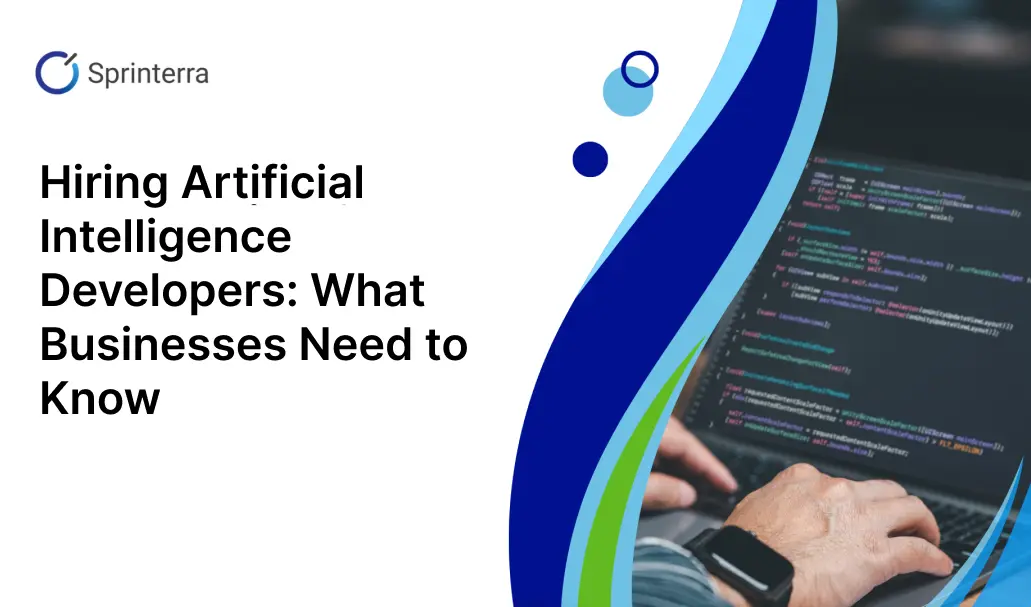
Artificial intelligence has shifted from an emerging technology on most organisations’ roadmaps to an operational reality that is reshaping how software is built, how products are designed, and how business processes are automated. For organisations that want to stay competitive, the question is no longer whether to invest in AI but how to do so effectively: whether to hire AI developers in-house, engage specialist AI development partners, or pursue a combination of both depending on the specific capabilities required.
Finding the right artificial intelligence developers is the most consequential decision in any AI development project. The quality of the technical team determines not just the initial project outcome but the long-term reliability, scalability, and maintainability of the AI systems built.
What AI Developers Actually Do
AI development is a multi-disciplinary technical field that encompasses several distinct specialisations. Data scientists focus on the statistical modelling and algorithm development that underlies AI systems. Machine learning engineers build and optimise the models that learn from data. Data engineers design and maintain the pipelines that collect, clean, and serve the data that AI models depend on. MLOps engineers build the infrastructure that deploys AI models to production and keeps them running reliably over time.
A common misconception is that AI development is primarily about the model development phase. In practice, data engineering and MLOps typically account for the majority of the engineering effort in a production AI system. An AI developer who is strong across the full stack, from data pipeline design through model development to production deployment, is considerably more valuable than one who is expert in model architecture but limited in the surrounding engineering disciplines that determine whether the model actually works in the real world.

The Skills That Actually Predict AI Development Quality
When evaluating AI developers, the skills that most reliably predict production-quality outcomes are different from the skills that feature most prominently in CVs and portfolio demonstrations. Mathematical sophistication in model architectures is important but rarely the limiting factor in real-world AI projects. The skills that most often determine whether an AI project succeeds or fails are:
- Data quality assessment: the ability to evaluate training data critically, identify the ways in which it may not represent the real-world distribution the model will face in production, and design the data collection and labelling processes needed to address these gaps
- Evaluation rigour: the ability to design evaluation frameworks that accurately measure model performance on the metrics that matter for the business application, rather than optimising for benchmark performance that does not translate to real-world value
- Software engineering discipline: the ability to build AI systems with the code quality, error handling, logging, and testing practices that make them maintainable and reliable in production over time
- Communication and domain understanding: the ability to understand business requirements deeply and translate them into precise technical specifications, avoiding the common failure mode where technically correct AI systems solve a slightly different problem from the one the business actually has
McKinsey on the State of AI Development
According to McKinsey’s research on the state of AI, organisations that achieve the strongest returns from AI investment are those that combine technical AI capability with clear use case prioritisation and the organisational structures to move from AI experimentation to production deployment at scale. The research consistently shows that the biggest barrier to AI value creation is not technical capability but the gap between prototype and production, which requires a combination of engineering rigour, change management, and the organisational alignment to integrate AI outputs into business workflows.
AI in Healthcare: A Growing Application Domain
One sector where AI development is producing particularly significant results is healthcare and mental health services. AI applications in this domain include clinical decision support systems that assist practitioners in diagnosis and treatment planning, patient triage tools that identify individuals who may benefit from specialist referral, and operational systems that improve the efficiency of appointment scheduling, follow-up, and care coordination.
Mental health services, where access constraints are significant and demand consistently outstrips capacity, represent a compelling application domain for AI tools that help practitioners identify patients most in need of specialist care and streamline the processes that connect patients to appropriate treatment. The combination of urgent social need and the availability of large datasets from electronic health records makes this one of the most active areas of AI application development in the healthcare sector.
In-House vs. External AI Development Partners
The decision between building AI capability in-house and engaging external AI development partners depends on several factors: the strategic importance of AI to the business, the volume and continuity of AI development work anticipated, and the availability of AI talent in the relevant market.
External AI development partners provide immediate access to specialist expertise without the recruitment timeline and cost of building an in-house team, the ability to scale up and down as project requirements evolve, and the cross-industry experience that comes from working across multiple AI development contexts simultaneously. They are most appropriate for organisations that have specific AI projects to deliver but do not yet have the AI workload to justify a full in-house team.
In-house teams provide deeper alignment with the organisation’s specific context and data, faster iteration cycles for AI features that are central to the product, and the institutional knowledge that accumulates over years of working with the same datasets and systems. They are most appropriate for organisations where AI is a core competitive differentiator and a continuous rather than project-based investment.
Final Thoughts
Hiring AI developers, whether in-house or through an external partner, is a decision that requires the same rigour as any other critical technical hire. Evaluating the full-stack engineering quality alongside the model development expertise, and assessing the communication and domain understanding that translates technical AI capability into business value, produces consistently better outcomes than evaluating AI developers primarily on their mathematical credentials. For organisations ready to move forward with AI development, Sprinterra AI for development provides the end-to-end AI engineering capability that production-quality AI systems require.