Medically reviewed by Yuli Fradkin, MD, board-certified psychiatrist | Last reviewed December 2026
Bipolar depression is often the hardest part of bipolar disorder to treat. The lows usually last longer than the highs, fewer medications are approved for them, and standard antidepressants can carry a risk of tipping someone into mania. So when people with bipolar disorder hear that TMS helps depression without medication, the question is natural: could it help me, and could it set off a manic episode?
This guide answers both questions directly. It covers how TMS is used for bipolar depression, what the research shows, the actual risk of switching into mania, who may be a candidate, how psychiatrists monitor patients during treatment and the main alternatives. Safety comes first throughout, because with bipolar disorder it has to. For our broader approach, see our page on bipolar disorder treatment in NYC.
What We Know
|
Is TMS used for bipolar depression?
Yes, but off-label and usually as an add-on. TMS devices are FDA-cleared for major depressive disorder, OCD, anxious depression and smoking cessation, not for bipolar depression. The National Institute of Mental Health notes that the FDA granted breakthrough device designation to rTMS for bipolar depression in 2020. That designation speeds up review for devices with preliminary evidence; it does not mean the FDA has cleared TMS for this use.
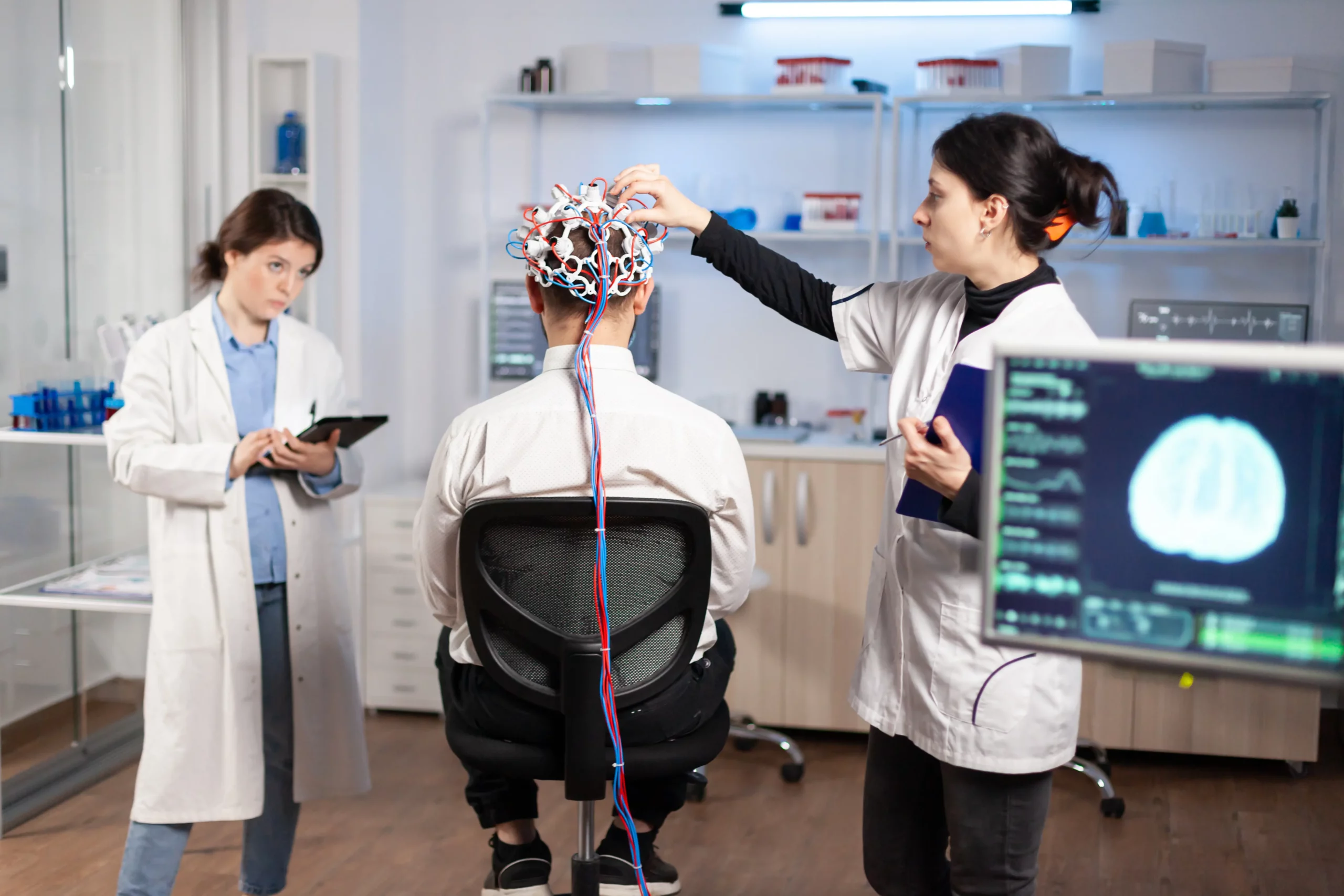
In practice, psychiatrists consider TMS for bipolar depression when a depressive episode has not responded to medication and mood is otherwise stable. It is used alongside a mood stabilizer, never instead of one. Off-label use is common and legal in psychiatry, but it means the evidence is less settled and insurance coverage is less likely, both of which we discuss with every patient.
What does the evidence show?
The evidence for TMS for bipolar depression is growing and mostly encouraging, but it comes from smaller and fewer studies than for unipolar depression. Here are the key findings:
| Study | Design | Main finding |
|---|---|---|
| Ventura et al., 2026 meta-analysis | 56 studies, 1,709 patients | Active TMS outperformed sham (effect size d = 0.40). Pooled response 46.8%, remission 28.3%, on par with unipolar depression |
| Tavares et al., 2017 | Deep TMS vs sham, 50 patients | Greater improvement at week 4. Response 48% vs 24% and remission 28% vs 16%, not statistically significant. No manic switches |
| Sheline et al., 2024 | Accelerated theta burst vs sham, 24 patients | Depression scores fell from 30.4 to 10.5 with active treatment vs 28.0 to 25.3 with sham |
The largest analysis, by Ventura and colleagues and indexed on PubMed, pooled 56 studies and concluded that active TMS had better antidepressant effects than sham in randomized trials. The deep TMS trial by Tavares and colleagues, published in Neuropsychopharmacology, showed a significant benefit on the main depression score at week 4, although the difference in response and remission rates did not reach statistical significance and had faded by week 8. A small randomized trial of accelerated theta burst stimulation in treatment-resistant bipolar depression, published in JAMA Psychiatry, found a large difference between active and sham treatment. Accelerated protocols like this one are still considered investigational by most insurers, and Village TMS currently offers standard daily TMS only.
The limits matter too. Many studies are small, protocols vary widely and some are open-label, so the right schedule and target for bipolar depression are not yet settled. A 2018 consensus statement from TMS clinicians in the Journal of Clinical Psychiatry judged the evidence insufficient for routine use in bipolar disorder at the time, and research since then has strengthened, though not closed, that case. For results in unipolar depression, see our TMS success rate article.

Can TMS trigger mania?
It can, but it is uncommon. In a pooled analysis of sham-controlled TMS trials in depression by Xia and colleagues in the International Journal of Neuropsychopharmacology, treatment-emergent mania or hypomania occurred in 0.84 percent of patients receiving active TMS and 0.73 percent receiving sham, a difference that was not statistically significant. Within that analysis, the estimated switch rate for the small group of bipolar patients on active TMS was higher, about 3.1 percent, although the authors cautioned that the estimate was limited by small trials.
The 2026 meta-analysis focused on bipolar depression found switch rates were low and equivalent to sham, with an odds ratio of 1.3 that was not statistically significant. Put plainly, the risk appears low and close to what happens without TMS, but people with bipolar disorder are more vulnerable to mood switches in general, so the risk is real enough to plan for.
Factors that may raise switch risk include:
- Not taking a mood stabilizer, or a dose that is not yet stable
- A recent manic or hypomanic episode, or rapid cycling
- Taking an antidepressant without a mood stabilizer
- Poor sleep, stimulants or substance use during treatment
Who is a candidate for TMS for bipolar depression?
A good candidate is someone with bipolar I or bipolar II disorder whose current depressive episode has not responded well enough to appropriate medication, whose mood is otherwise stable on a mood stabilizer and who can attend near-daily sessions. Our bipolar disorder treatment page explains that medication comes first and that a recent manic episode or rapid cycling usually means stabilizing before adding TMS.
The usual TMS safety screening also applies:
- No ferromagnetic or magnetic-sensitive implants near the head, such as certain aneurysm clips, cochlear implants or implanted stimulators
- Careful review of any seizure history, head injury or medications that lower the seizure threshold. The consensus estimate for seizure risk is about 1 in 30,000 treatments, or fewer than 1 in 1,000 patients
- No active psychosis, and no current substance use that would make monitoring unreliable
Our TMS therapy page covers how a standard course works, typically 30 to 36 sessions over 6 to 9 weeks.
How do psychiatrists monitor for mania during TMS?
Monitoring is the part of TMS for bipolar depression that matters most. The 2018 clinician consensus recommends daily assessment for emerging manic or hypomanic symptoms during TMS, such as agitation or irritability, and reevaluating the plan, including the mood stabilizer, if they appear.
At Village TMS, that monitoring includes:
- Before starting: confirming the diagnosis, mapping past manic, hypomanic and mixed episodes, and checking that your mood stabilizer dose is steady
- Before each session: asking about sleep, energy, irritability and racing thoughts. Needing less sleep without feeling tired is often the earliest warning sign
- During the course: your psychiatrist reviews both depression and mania rating scales
- If mood rises: treatment is paused, your prescriber is contacted and medication may be adjusted
- With your consent: involving a partner or family member, who often notice early changes first
What are the alternatives for bipolar depression?
Medication remains the foundation. Several drugs are FDA-approved specifically for bipolar depression, including quetiapine, lurasidone, cariprazine, lumateperone and the olanzapine and fluoxetine combination. Lithium is approved for mania and long-term maintenance, and it remains one of the most effective long-term treatments and is associated with lower suicide risk. Psychotherapy, including cognitive behavioral therapy and interpersonal and social rhythm therapy, helps alongside medication.
Ketamine is sometimes considered off-label for bipolar depression, added to a mood stabilizer. The evidence suggests it can act quickly but that the benefit is often short-lived. A 2024 systematic review in Frontiers in Psychiatry found the effect in bipolar depression lasted only a few days in most studies and rated the certainty of the evidence as low. Our ketamine therapy page explains how we use it and who it is not suitable for.
Spravato is FDA-approved for treatment-resistant major depression, not bipolar depression, and its main trials did not include people with bipolar disorder. For severe or life-threatening bipolar depression, electroconvulsive therapy remains an option at a hospital, as our TMS vs ECT comparison explains.
| Option | Regulatory status for bipolar depression | Role |
|---|---|---|
| FDA-approved medications | Approved | First-line, often with a mood stabilizer |
| Lithium | Approved for mania and maintenance | Long-term foundation for many patients |
| TMS | Off-label (breakthrough designation, not cleared) | Add-on when depression persists despite medication |
| IV or IM ketamine | Off-label | Add-on, fast but often short-lived effect |
| ECT | Used for severe or urgent cases | Hospital-based option for severe depression |
Does insurance cover TMS for bipolar depression?
Usually not. Because TMS is not FDA-cleared for bipolar depression, most insurance policies treat it as investigational for this use, and coverage criteria for TMS are written around major depressive disorder. Some patients with bipolar disorder pay for TMS themselves, and our team explains your expected costs before you start. Our guide to what insurers require for TMS and our TMS therapy cost page cover coverage in more detail. Among the plans we work with, Aetna and Optum list bipolar disorder as an experimental or unproven use of TMS, Cigna lists bipolar depression among uses where TMS is not proven, TRICARE covers TMS for major depressive disorder only and names bipolar disorder as not covered, and Medicare’s New York policy is written for major depressive disorder.
Getting bipolar depression treatment in NYC
If you live with bipolar disorder and your depression has not lifted on medication, a careful evaluation is the first step. Our psychiatrists review your mood history, current medications and safety factors before recommending whether TMS, a medication change, ketamine or another approach makes sense. Our page on how we choose a treatment explains that process, and our comparison of TMS vs Spravato vs ketamine sets out how the options differ.
If you notice signs of mania, such as needing much less sleep, racing thoughts or unusually risky behavior, contact your psychiatrist promptly. If you are in crisis or having thoughts of suicide, call or text 988 or call 911.
Call 646-817-2835 or contact us to book a free consultation.