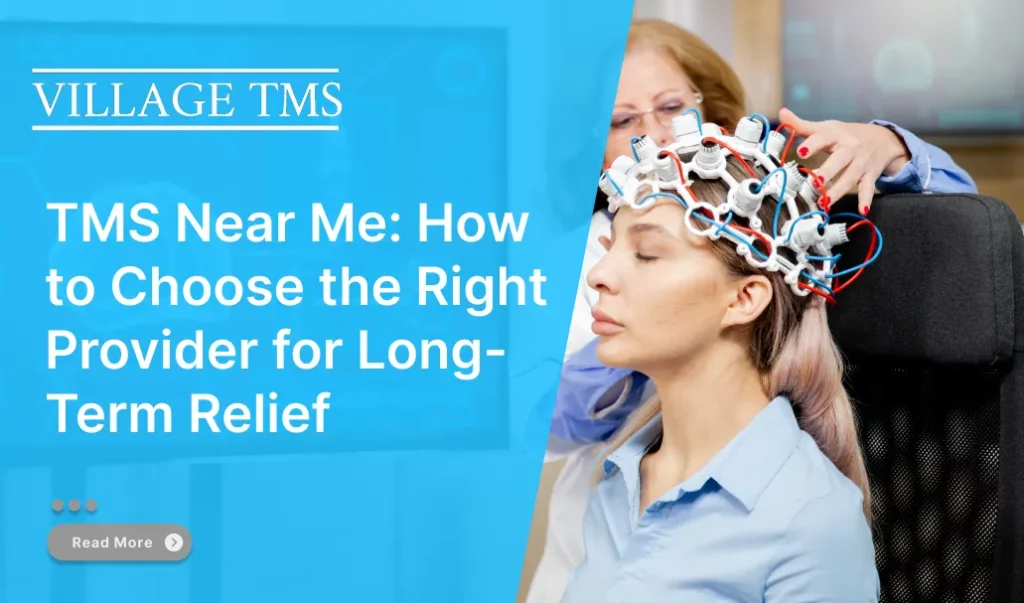
If you have been told you have treatment-resistant...Read More

Transformative Care for Mind and Life
If you’ve been searching for TMS Therapy NYC, you’re likely looking for a safe, medication-free treatment for depression that actually works. At Village TMS in Manhattan, we provide FDA-approved Transcranial Magnetic Stimulation for individuals struggling with major depressive disorder and treatment-resistant depression. Our NYC medical center combines advanced neuromodulation with compassionate psychiatric care to support long-term mood stability without systemic side effects.
TMS Therapy NYC is a non-invasive brain stimulation treatment that targets underactive regions of the brain involved in mood regulation. Using focused magnetic pulses, TMS activates neurons in the dorsolateral prefrontal cortex, an area associated with depression symptoms.


Unlike antidepressant medications that circulate throughout the body, TMS therapy works directly on specific neural circuits. Many patients in New York City pursue TMS Therapy NYC after trying multiple medications without meaningful improvement. By promoting neuroplasticity and restoring healthier cortical activity patterns, TMS may support sustained emotional balance over time.
Get help with depression today! It’s important to know that you are not alone.
Studies of TMS have examined its therapeutic potential for treating various diseases, with depression being the most thoroughly studied. In the late 1990s, researchers worldwide published more than 20 randomized, controlled trials studying TMS as a depression treatment.
Now, more and more research continues to emerge around the many beneficial uses for TMS, for depression and beyond. Research indicates TMS Therapy to be beneficial in treating depression, anxiety, obsessive-compulsive disorder, post-
traumatic stress disorder, attention deficit hyperactivity disorder, bipolar disorder, dementia, and more!
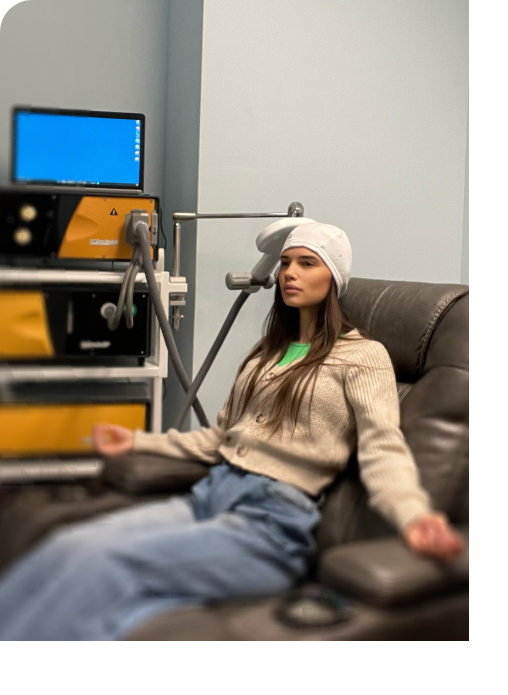
Session Experience: During TMS Therapy NYC sessions, you sit comfortably while the device delivers light rhythmic tapping to the scalp. Most patients read, meditate, or work remotely. There is no anesthesia and no recovery period.
Treatment Schedule: A standard protocol includes five sessions per week for 4–6 weeks. Consistency helps strengthen neural pathways involved in mood regulation.
Long-Term Results: Many individuals report improved mood, focus, and energy within the first few weeks. Booster sessions may be recommended to maintain progress depending on symptom stability and clinical response.
TMS Therapy NYC in our Manhattan office offers a strong safety profile. Because it is non-systemic, it does not cause weight gain, sedation, or sexual dysfunction commonly associated with antidepressants.
TMS is FDA-approved for major depressive disorder and treatment-resistant depression and is increasingly used in other psychiatric conditions under medical supervision.
Patients seeking TMS Therapy NYC often experience ongoing depressive symptoms despite medication management.
We assist with prior authorization and verify insurance coverage before your first appointment. Many insurance plans cover TMS therapy when treatment-resistant depression criteria are met.
Our Manhattan team provides clear explanations of co-pays, deductibles, and documentation requirements. TMS Therapy NYC should be transparent, medically structured, and financially understandable for every patient.
Personalized Protocols: Tailored pulse patterns based on your brain mapping.
Expert Interventional Psychiatry: Our experienced physicians specialize in brain care and Mental Health Services tailored to your unique needs.
Holistic Support: Nutritional guidance and stress-management resources complement your treatment.
Begin Your Revival Today
Starting is simple: Schedule a free consultation to explore if TMS aligns with your goals. We’ll review your history, answer questions, and craft a roadmap to resilience.
Rediscover joy, energy, and clarity—let TMS illuminate your path to wellness.
Patient-Centric Focus: Emphasizes comfort, convenience, and long-term wellness.
Expanded Conditions: Highlights TMS for OCD, PTSD, and chronic pain.
Success Metrics: Integrates data on improvement rates and longevity of results.
Safety Reassurance: Details protocols and side effect management.
Financial Clarity: Addresses insurance and support options.
Unique Clinic Value: Showcases personalized technology and holistic care.
This rewrite offers a fresh narrative, deeper insights, and answers to unspoken patient questions while maintaining an uplifting, empowering tone.
If you have been told you have treatment-resistant...Read More
If you have tried antidepressants, adjusted the dosage,...Read More
If you are exploring Transcranial Magnetic Stimulation as...Read More
Finding reliable TMS providers near me is no...Read More
Living with attention challenges affects more than focus....Read More
When you type “TMS near me” into Google,...Read More
Take this next step, we’ll help with the others.
We proudly serve patients throughout:
Manhattan: Union Square, Chelsea, Flatiron, Greenwich Village, West Village, East Village, Midtown, Upper East Side, Upper West Side, Harlem, Tribeca, SoHo
Brooklyn & Queens: Brooklyn Heights, Williamsburg, Park Slope, Long Island City, Astoria, Forest Hills
New Jersey: Hoboken, Jersey City, Weehawken, West New York, North Bergen, Fort Lee, Edgewater, Secaucus, Newark, and surrounding South Bergen communities
If you’re searching for TMS therapy near Manhattan, Brooklyn, Queens, or Hoboken, our centrally located NYC office makes treatment convenient and accessible.
TMS Therapy NYC refers to Transcranial Magnetic Stimulation delivered in a certified medical setting in New York City. It uses magnetic pulses to stimulate specific areas of the brain involved in mood regulation rather than affecting the entire body like medication.
Antidepressants typically influence neurotransmitters such as serotonin or norepinephrine. TMS directly stimulates neural circuits in the prefrontal cortex, promoting neuroplasticity and improved cortical connectivity. Because it is non-systemic, it avoids many medication-related side effects.
For individuals with treatment-resistant depression, TMS Therapy NYC offers a structured neuromodulation approach that targets the biological roots of depressive symptoms.
TMS Therapy NYC is commonly recommended for adults diagnosed with major depressive disorder who have not responded to multiple antidepressants. It may also be considered for individuals who cannot tolerate medication side effects.
A psychiatric evaluation assesses eligibility by reviewing mood history, medication trials, and symptom severity. Patients experiencing persistent sadness, fatigue, brain fog, or loss of interest despite treatment may benefit from neuromodulation therapy.
Structured outpatient care in Manhattan ensures proper screening and safe treatment planning.
A typical course lasts 4–6 weeks with five sessions per week. Each session takes about 20–40 minutes depending on the stimulation protocol and individual motor threshold mapping.
Clinical improvement builds gradually through repeated cortical stimulation. Many patients notice improved energy, concentration, and mood during the treatment course. Booster sessions may be considered if symptoms return after the initial series.
Consistency and adherence to the full schedule improve overall outcomes.
Yes. TMS therapy has been extensively studied and cleared by the FDA for major depressive disorder. Because it is non-invasive and non-systemic, it does not involve anesthesia or sedation.
Side effects are usually mild and may include temporary scalp discomfort or headache. Before starting TMS Therapy NYC, providers review seizure history, medical conditions, and psychiatric background to ensure safe delivery.
Certified TMS providers supervise each session in our Manhattan clinic to maintain structured medical oversight.
Many insurance providers cover TMS therapy for treatment-resistant depression when documentation requirements are met. Prior authorization is typically required before beginning treatment.
Our Manhattan office assists with insurance verification, clinical documentation submission, and explanation of co-pays or deductible responsibilities. Insurance approval significantly reduces out-of-pocket expenses for eligible patients.
Understanding coverage details before starting TMS Therapy NYC prevents financial uncertainty during the treatment course.
Yes. Many patients continue cognitive behavioral therapy, medication management, or other psychiatric services while receiving TMS therapy.
Combining neuromodulation with psychotherapy may strengthen long-term mood stability. TMS Therapy NYC often functions as part of a broader outpatient psychiatric treatment plan designed to support relapse prevention and sustained recovery.
If you experience mood swings between depression and periods of unusually high energy, impulsivity, or reduced need for sleep, a psychiatric evaluation is important.
Bipolar Disorder Treatment NYC begins with a thorough diagnostic assessment, including symptom history and previous treatment response. Early identification improves long-term stability and reduces complications.
The first step in starting TMS Therapy NYC is a psychiatric consultation. During this visit, providers review symptom history, medication response, and overall mental health stability.
If eligible, motor threshold mapping is scheduled to determine stimulation intensity. Insurance verification and prior authorization are completed before the first treatment session. Structured planning supports consistent care and improved clinical outcomes.
Yes. TMS is highly effective in reducing symptoms of depression and providing relief for those facing severe depression or other behavioral health challenges. It targets specific areas of the brain linked to mood regulation, improving emotional stability over time.
Absolutely. TMS is FDA-approved in the United States for the treatment of major depressive disorder and other mood-related conditions. It offers a safe, medication-free alternative that’s gaining recognition in behavioral health clinics nationwide.
We use cookies to improve your experience on our site. By using our site, you consent to cookies.
Manage your cookie preferences below:
Essential cookies enable basic functions and are necessary for the proper function of the website.
These cookies are needed for adding comments on this website.
Google reCAPTCHA helps protect websites from spam and abuse by verifying user interactions through challenges.
Google Tag Manager simplifies the management of marketing tags on your website without code changes.
You can find more information in our Cookie Policy and Privacy Policy.