By the time most people reach our office, they have already tried two or three antidepressants, sometimes more, and they are tired of being told to wait another six weeks. They usually arrive with one question: which of these treatments should I try? It is the right question, and it does not have a single answer. TMS, Spravato and ketamine all have real evidence behind them for treatment-resistant depression, but they work differently, feel different, fit different schedules and are covered differently by insurance. Choosing well means matching the treatment to the person, not the other way around.
This guide explains how the psychiatrists at Village TMS make that decision. It covers what treatment-resistant depression means, the factors we weigh, how the three options compare side by side, how insurance shapes the choice and what happens if the first option does not work. It describes how we think, and it is not a substitute for your own evaluation. For the clinical background on the diagnosis itself, see our treatment-resistant depression page.
What We Know
|
What counts as treatment-resistant depression?
Depression is generally considered treatment-resistant when it has not improved enough after two or more antidepressants, each taken at an adequate dose for about six to eight weeks. It is common rather than rare, and it is a signal that a different plan is needed, not a verdict that nothing will work.
Before we compare treatments, we check whether the label actually fits. Several things can make depression look resistant when the real issue lies elsewhere:
- An underlying condition that changes the treatment plan, such as bipolar disorder, thyroid dysfunction, a co-occurring anxiety disorder or PTSD
- Earlier medications that were never taken at a full dose, or were stopped before they had time to work
- Side effects that made consistent use impossible, which is a different problem from a medication not working
- Life circumstances, sleep problems or substance use that keep symptoms going regardless of treatment
Getting this right matters because the answer changes the recommendation. Depression that turns out to be part of bipolar disorder, for example, calls for a different approach from the start, which our bipolar disorder treatment page explains in more detail.
Why not try another antidepressant first?
Another medication can still be the right step, especially if earlier trials were too short or too low in dose. But the research suggests that each additional similar medication helps fewer people. In the NIMH STAR*D study, about one-third of participants reached remission on the first medication, roughly 25 percent to one-third at the second step, 12 to 20 percent at the third, and 7 to 10 percent at the fourth.
The same study also carries a hopeful message. Among participants who stayed in treatment, the original investigators reported that about two-thirds eventually became symptom-free, although a 2023 reanalysis put the figure closer to one-third, (Pigott et al., BMJ Open 2023;13:e063095), and NIMH notes that full benefit from a medication step may take 10 to 12 weeks. The lesson we take from it is to keep going and to change strategy when the odds of the current approach are falling. For many patients who have already been through two or more medications, that means a treatment that works through a different mechanism, such as brain stimulation or the glutamate system targeted by ketamine and esketamine.

What do we look at first?
Safety comes first, because it decides which options are even on the table. Each treatment has its own screening requirements, and a condition that rules out one option may not rule out the others. That is one practical advantage of a practice that offers all three: a no for one treatment rarely means a no for everything.
TMS screening
TMS is not appropriate for people with certain metal or magnetic implants near the head, and a personal history of seizures calls for careful evaluation, since seizure is the rare serious risk of TMS. Our article on TMS therapy side effects lists the risk factors we screen for.
Spravato screening
Spravato raises blood pressure temporarily and can cause sedation and dissociation. The FDA prescribing information lists aneurysmal vascular disease, arteriovenous malformation, a history of bleeding in the brain and hypersensitivity to esketamine or ketamine as contraindications. Our team screens for high blood pressure, breathing problems and vascular conditions before a first dose, as described on our Spravato NYC page.
Ketamine screening
IV and IM ketamine share some of Spravato’s considerations and add others. Uncontrolled high blood pressure, active psychosis, active mania, a recent heart attack or stroke, severe liver disease, pregnancy and an active substance use disorder involving dissociative drugs generally rule ketamine out. Our guide to who is not a good candidate for ketamine therapy separates the firm exclusions from the conditions that only need a closer look.
How severe and how urgent is your depression?
Urgency changes the order of options. When depression is severe and relief is needed quickly, a faster-acting treatment may come first. When symptoms are serious but stable, a gradual treatment with fewer side effects may be the better starting point.
Spravato is FDA-approved for treatment-resistant depression and for depressive symptoms in adults with major depressive disorder who have acute suicidal thoughts or behavior, and some patients notice changes within hours to days. Ketamine can also act quickly. TMS builds more slowly: some patients notice shifts in mood, energy or sleep in weeks two or three, while others see the most meaningful change in weeks four through six, as described on our TMS therapy page.
For depression that is severe, psychotic, catatonic or life-threatening, a hospital level of care may be safer than any outpatient option, and electroconvulsive therapy remains the most effective treatment in those situations. Our comparison of TMS vs ECT explains when that applies. If you or someone you know is in crisis or having thoughts of suicide, do not wait for an appointment: call or text 988, the Suicide and Crisis Lifeline, or call 911, or go to the nearest emergency room.
How do TMS, Spravato and ketamine compare?
Each option has a distinct profile. The table below summarizes how they differ on the points patients ask about most, using the session and course details we follow at Village TMS.
| TMS | Spravato | IV or IM ketamine | |
|---|---|---|---|
| How it works | Magnetic pulses stimulate a mood-regulating region of the prefrontal cortex | Esketamine nasal spray acting on the brain’s glutamate and NMDA receptor system | Ketamine acting on the same glutamate and NMDA system |
| FDA status | FDA-cleared for major depression; some devices are also cleared for OCD, anxious depression or smoking cessation | FDA-approved for treatment-resistant depression and for depression with acute suicidal thoughts | Used off-label for mood disorders |
| Visit length | About 20 to 30 minutes | Dose plus at least 2 hours of monitoring | About 40 minutes plus monitoring |
| Typical course | About 36 sessions over roughly 6 weeks | Twice weekly in weeks 1 to 4, weekly in weeks 5 to 8, then weekly or every 2 weeks | An initial series, often 6 to 8 sessions over 3 to 4 weeks in our psychotherapy program |
| Speed | Gradual, usually over several weeks | Can be within hours to days | Can be within hours to days |
| Common side effects | Scalp discomfort, headache | Dissociation, dizziness, nausea, sedation, blood pressure rise | Dreamlike dissociation, dizziness, nausea |
| Driving | Drive yourself home | No driving until the next day after restful sleep | No driving on treatment days |
| Insurance | Covered by most major plans with criteria | More often covered than IV or IM ketamine | Often self-pay or out of network |
No column in that table is the winner. A treatment that is ideal for one person can be the wrong fit for the next, which is why the remaining factors matter as much as the evidence. For a closer look at the two medication-based options, our Spravato vs IV ketamine comparison goes through the differences in detail.

Which side effects can you live with?
Side effect profiles are one of the clearest dividing lines. TMS side effects are mostly local: discomfort at the treatment site and headache, usually easing within the first week or two. TMS involves no anesthesia, has no known effect on memory and does not produce the systemic effects of antidepressant pills, such as weight gain or sexual side effects.
Spravato and ketamine produce a temporary altered state. Many patients describe floating or dreamlike sensations and a distorted sense of time that fade as the session ends, along with possible dizziness and nausea. Some people find that experience unsettling. Others find it meaningful, especially with therapeutic support around it. Our articles on what ketamine therapy feels like and ketamine therapy side effects describe both in plain language, so you can decide how you feel about it before your first session.
How does your schedule shape the choice?
Logistics decide more treatment plans than people expect. A treatment you cannot attend consistently will not work, however strong its evidence. We ask about your work, family and travel before recommending anything.
- TMS asks for frequent short visits, about five per week for roughly six weeks, but you drive yourself and can go straight back to work
- Spravato starts with two visits a week for the first month, then tapers to weekly or every other week; each visit includes at least two hours of monitoring, and you need a ride home every time
- Ketamine sessions run about 40 minutes plus monitoring, and you cannot drive on treatment days
Our office is open Monday through Friday from 8am to 9pm, Saturday from 8am to 5pm and Sunday from 9am to 3pm, which helps many patients fit daily TMS around a working day. Shorter TMS schedules also exist. Our article on accelerated TMS and SAINT explains how compressed protocols work and why many insurers still treat them as investigational.
How does insurance affect the recommendation?
Coverage never overrides safety or clinical fit, but when two options are both reasonable, cost is a fair tiebreaker and we discuss it openly. The three treatments sit in very different places with insurers.
TMS is covered by most major plans for treatment-resistant depression once criteria are met, and Village TMS is in network with Aetna, BCBS, Cigna, United, Empire BCBS, Oxford and Medicare. Many insured patients pay $0 to $50 per session, depending on their plan, as explained on our TMS therapy cost page, and our guide to what each insurer requires for TMS walks through carrier criteria.
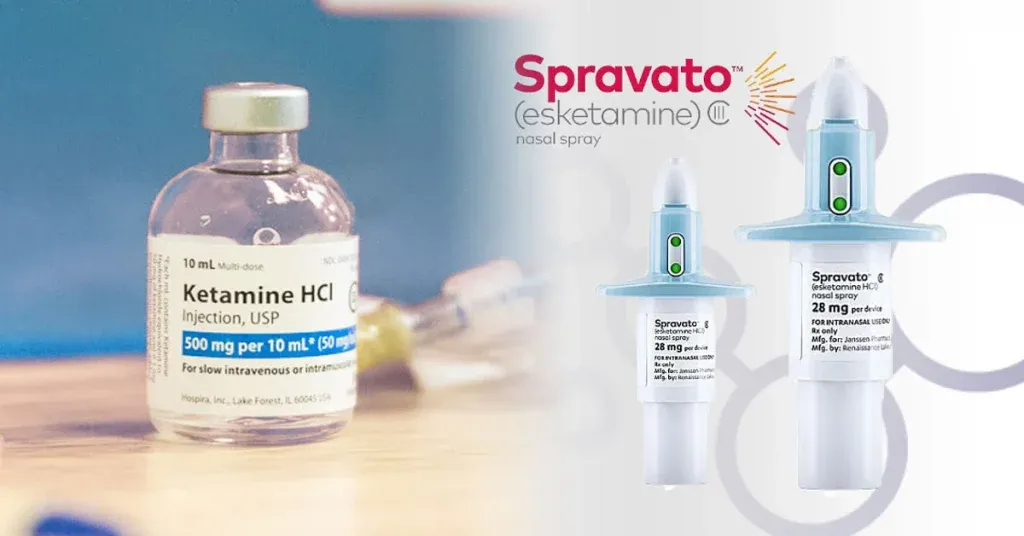
Spravato is FDA-approved and given in a certified clinic, which is why it is more often covered than IV or IM ketamine. Our breakdown of how much Spravato costs covers the medication, the monitoring and the manufacturer’s savings programs. IV and IM ketamine are used off-label and are frequently self-pay, with IM usually costing less per session than IV. Our ketamine insurance coverage guide explains what to expect. We verify your benefits for free before you commit to anything.
Do you want therapy built into treatment?
Some patients want a medical treatment and nothing more. Others want the treatment to open space for therapeutic work. Both are valid, and the answer points toward different plans.
Our ketamine-assisted psychotherapy program pairs medically supervised dosing with preparation and integration sessions led by Sofia Dro, MA, a psychotherapist who works with Internal Family Systems and somatic methods. Preparation sets an intention and addresses fears before dosing, and integration afterward helps insights carry into daily life. TMS and Spravato can also be combined with psychotherapy, and our mental health support services include psychiatric evaluation, medication management and therapy such as cognitive behavioral therapy.
Can treatments be combined?
Yes, in many cases. Many patients continue their antidepressant during TMS, and some receive Spravato alongside TMS, psychotherapy or medication management. Combining treatments is a clinical decision rather than a default, and it depends on your history, your response and how much each additional piece adds.
Spravato was originally approved for use together with an oral antidepressant. In January 2025, the FDA also approved it as a standalone treatment for adults with treatment-resistant depression, which gives psychiatrists more flexibility for patients who could not tolerate oral antidepressants. For depressive symptoms with acute suicidal thoughts or behavior, Spravato is still used together with an oral antidepressant Your psychiatrist will explain which approach fits you.
What does this look like in practice?
The examples below are illustrative composites, not real patients. They show how the same factors lead to different starting points.
- A full-time professional who has tried three antidepressants, lives near the office, has no seizure history and wants to avoid more medication side effects: TMS is often the first option we discuss.
- A patient with severe symptoms and intermittent suicidal thoughts who is safe for outpatient care and has commercial insurance: Spravato is often discussed early because of its approval and faster onset, alongside a clear safety plan.
- Someone whose insurance covers Spravato but who cannot spare two hours and a ride twice a week: TMS, or a Spravato schedule built around their availability, becomes the practical question.
- A patient who wants a therapy-centered approach, is open to the altered state of ketamine and can pay out of pocket: ketamine-assisted psychotherapy may be the best fit.
- A patient whose depression turns out to be part of bipolar disorder: mood stabilization comes first, and any further option is chosen with that in mind, as covered on our ketamine for bipolar page.
For that last group, our page on ketamine for bipolar disorder explains how we approach treatment when mood switching is a risk.

What happens if the first choice does not work?
A treatment that does not work is information, not failure. We track progress with validated rating scales throughout treatment, so a lack of improvement shows up early and the plan can change rather than drift.
- If TMS produces a partial response, the protocol can be adjusted or extended, and deep TMS may be considered for some conditions, as our deep TMS vs standard TMS guide explains
- If TMS does not help, Spravato or ketamine works through a different mechanism and remains available
- If Spravato or ketamine does not help, TMS remains available, and the reverse is equally true
- If depression is severe and outpatient options are not enough, we will say so directly and help you reach a higher level of care
Realistic expectations help here. Our article on TMS success rates and our roundup of what Spravato patients report show what the research predicts, including the share of patients who do not respond to a first course.
What should you bring to your consultation?
The more complete your history, the better the recommendation. Before your free consultation, gather what you can:
- Every antidepressant you have taken, with the dose, how long you took it and why you stopped
- Any therapy you have had, including the type and how long it lasted
- Your current medications and supplements
- Medical history that affects safety, such as seizures, implants, high blood pressure, heart or vascular conditions, and pregnancy
- Your insurance card, so we can verify coverage
- Your goals and any limits on your schedule or travel
If you are a clinician, our provider referral page explains how to refer a patient. If you are still comparing practices, our page on finding a TMS provider covers what to look for, and our complete guide to TMS therapy and ketamine therapy page are good places to start reading.
Call 646-817-2835 or contact us to book a free consultation.