Medically reviewed by Yuli Fradkin, MD, board-certified psychiatrist | Last reviewed November 2026
If two or more antidepressants have not lifted your depression, you have probably come across three names more than any others: TMS, Spravato and ketamine. Each has real evidence behind it, and each is offered as the answer on someone’s website. The honest version is that they are different tools. They work through different mechanisms, ask different things of your schedule, carry different side effects and sit in very different places with insurers.
Village TMS offers all three, so we have no reason to favor one, whether the question is TMS vs ketamine, TMS vs Spravato or Spravato vs ketamine. This guide compares them side by side: how each works, how quickly it acts, how much time it takes, its side effects, its cost and coverage, whether they can be combined, and how we decide together. For how this fits our clinical process, see how we choose a treatment.
What We Know
|
TMS vs Spravato vs ketamine at a glance
The table below summarizes the main differences. Each row is explained in the sections that follow.
| TMS | Spravato | IV or IM ketamine | |
|---|---|---|---|
| What it is | Magnetic pulses aimed at a mood-regulating brain region | Esketamine nasal spray | Ketamine given by infusion or injection |
| FDA status for depression | FDA-cleared device | FDA-approved drug | Off-label use |
| Speed | Gradual, over several weeks | Can be within hours to days | Can be within hours to days |
| Typical course | 30 to 36 sessions over 6 to 9 weeks | Twice weekly for 4 weeks, then weekly or every 2 weeks | An initial series, then maintenance if needed |
| Visit length | About 20 to 30 minutes | Dose plus at least 2 hours of monitoring | About 40 minutes plus monitoring |
| Driving afterward | Yes | Not until the next day | Not on treatment days |
| Main side effects | Scalp discomfort, headache | Dissociation, dizziness, nausea, sedation, blood pressure rise | Dissociation, dizziness, nausea, blood pressure rise |
| Insurance | Often covered with prior authorization | Often covered with prior authorization | Usually self-pay |
How does each treatment work?
TMS, or transcranial magnetic stimulation, uses an electromagnetic coil placed against the scalp to deliver repeated magnetic pulses to the prefrontal cortex, an area involved in mood regulation. The National Institute of Mental Health describes rTMS as FDA-cleared for treatment-resistant depression, OCD, migraine, anxiety with depression and smoking dependence. Nothing enters your bloodstream, so it avoids the whole-body side effects of medication. Our TMS therapy page explains how a course works.
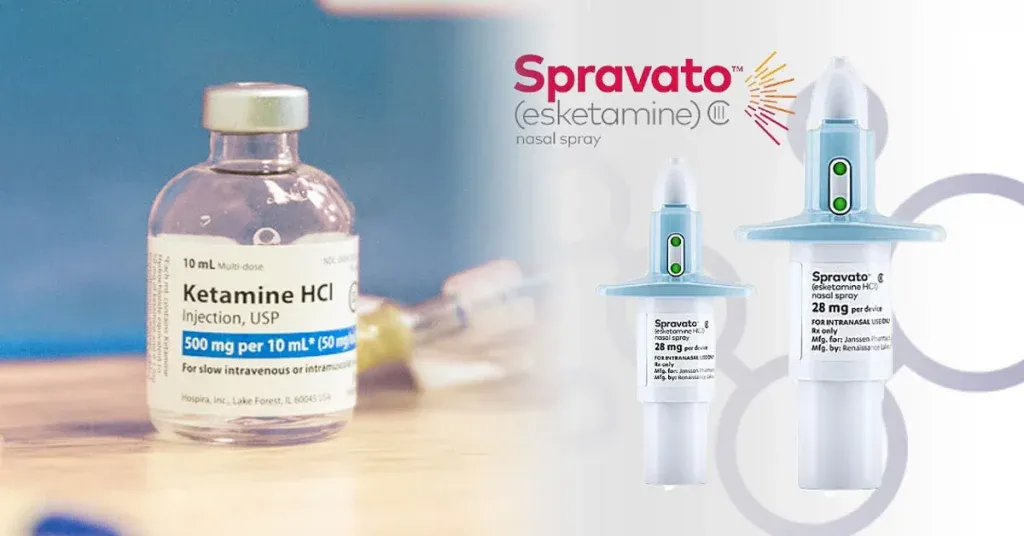
Spravato and ketamine both act on the brain’s glutamate system by blocking the NMDA receptor. Spravato is esketamine, one of the two mirror-image forms that make up ketamine, delivered as a nasal spray. The Spravato prescribing information states that the exact way it relieves depression is unknown. IV and IM ketamine use the full ketamine molecule, which the FDA has approved as an anesthetic rather than for depression. Our pages on Spravato treatment in NYC and ketamine therapy cover each in more detail.
So the core question in TMS vs Spravato is stimulation versus medication, and the core question in Spravato vs ketamine is an FDA-approved, closely regulated spray versus an off-label drug with more flexibility in how it is given. Our Spravato vs IV ketamine comparison goes deeper on that second pair.
What does the research show for each?
Each treatment has controlled trial evidence, but the studies used different patients and measures, so the numbers below describe each treatment on its own terms rather than ranking them.
- TMS. In an NIMH-funded, sham-controlled trial published in Archives of General Psychiatry, 14.1 percent of patients receiving active TMS reached remission compared with 5.1 percent on sham. Real-world clinic data shows higher rates, which our TMS success rate article explains.
- Spravato. In a relapse-prevention study published in JAMA Psychiatry, patients in stable remission who continued Spravato had a 51 percent lower risk of relapse than those switched to placebo.
- IV ketamine. In the ELEKT-D trial of 403 patients published in the New England Journal of Medicine, 55.4 percent of patients receiving ketamine responded, compared with 41.2 percent receiving electroconvulsive therapy, in people with treatment-resistant depression without psychosis.
None of these trials compared TMS, Spravato and ketamine directly. That is why the choice usually turns on safety, speed, schedule, side effects and coverage rather than on a single success rate.

Which works fastest?
On speed, TMS vs ketamine is the clearest contrast: Spravato and ketamine usually act faster than TMS. In the Spravato studies of depression with acute suicidal thoughts, a difference from placebo appeared as early as 4 hours after the first dose, and in the main treatment-resistant depression study most of the week 4 benefit was already visible at 24 hours, according to the label.
TMS works more gradually. NIMH describes a typical course as daily sessions five days a week for four to six weeks, and many patients notice changes in sleep, energy or mood over several weeks before the full effect. Accelerated TMS schedules compress treatment, and NIMH notes that they can work much faster, often within a week. Our article on accelerated TMS and SAINT explains those protocols and their insurance status. Village TMS currently offers standard daily TMS only, and most of the insurers we work with do not cover accelerated protocols.
Faster is not automatically better. Spravato and ketamine benefits usually depend on ongoing maintenance sessions, while TMS benefits often last for months after a course ends.
How much time does each take?
The three treatments ask for very different patterns of time:
- TMS: frequent short visits, typically 30 to 36 sessions over 6 to 9 weeks, each about 20 to 30 minutes. You drive yourself and can go straight back to work.
- Spravato: fewer but longer visits, each with at least 2 hours of monitoring, twice weekly for the first 4 weeks and then less often. You need a ride home every time.
- IV or IM ketamine: sessions of about 40 minutes plus monitoring, usually as an initial series followed by maintenance if needed. You cannot drive on treatment days.
For someone who can spare half an hour before work but not two and a half hours twice a week, TMS can be the more practical choice. For someone who can block off two afternoons a week but not commit to near-daily visits, Spravato may fit better. Our guide to what happens during Spravato treatment shows what a Spravato day involves.

How do the side effects compare?
TMS side effects are mostly local and mild. NIMH lists discomfort at the coil site, facial or scalp twitching, headache and lightheadedness, and seizure is a rare serious risk that screening is designed to prevent. TMS needs no anesthesia and does not affect memory. Our article on TMS therapy side effects covers them in full.
Spravato and ketamine produce a temporary altered state. In the Spravato trials, dissociation affected 41 percent of patients compared with 9 percent on placebo, along with dizziness, nausea, sedation and a rise in blood pressure that peaks about 40 minutes after a dose. Both carry a risk of misuse, and Spravato is a Schedule III controlled substance. Our guides to Spravato side effects and ketamine therapy side effects explain what to expect.
How do cost and insurance compare?
Insurance treats the three very differently. TMS and Spravato are often covered for treatment-resistant depression once a plan’s criteria are met, usually with prior authorization. IV and IM ketamine are used off-label, so they are usually self-pay. At Village TMS, we are in network with Aetna, Cigna, Optum and TRICARE East (Humana Military) for both TMS and Spravato, and with Medicare for TMS. For other plans we can request a single case agreement, though approval is the insurer’s decision. We do not currently accept Medicaid, and we do not bill Medicare for Spravato.
Your actual cost depends on your plan’s deductible, copay and coinsurance, and on how many sessions you need. Our team verifies coverage for free before you start. For details, see our pages on TMS therapy cost, what insurers require for TMS, how much Spravato costs and ketamine insurance coverage.
Can treatments be combined?
Sometimes. Many patients continue an oral antidepressant during TMS, and Spravato is approved either on its own or together with an oral antidepressant for treatment-resistant depression. Some patients receive TMS and Spravato or ketamine during the same period, or move from one to another, under a psychiatrist’s supervision.
Research on combining TMS with Spravato or ketamine is still limited, so combination is a case-by-case decision rather than a standard protocol. A treatment that does not work is also not the end of the road: because these options act through different mechanisms, a poor response to one says little about how you will respond to another. Coverage matters here too: Aetna’s TMS policy lists adjunctive use of ketamine with TMS as experimental, so a combined plan may not be covered even when each treatment alone would be.

Where does tDCS fit?
tDCS, or transcranial direct current stimulation, is sometimes compared with TMS because both stimulate the brain without surgery. tDCS uses a weak electrical current through electrodes on the scalp rather than magnetic pulses. In December 2025, the FDA approved the first at-home tDCS headset, Flow FL-100, as a prescription treatment for adults with moderate to severe major depression, as reported by Psychiatric News.
The key difference for most of our patients is who each is for. The tDCS device’s approved use excludes people whose depression is considered treatment-refractory to medication, while TMS is cleared specifically for depression that has not improved with antidepressants. Village TMS does not offer tDCS.
How we decide together
No single treatment is best for everyone with treatment-resistant depression. We start with a full psychiatric evaluation and weigh several factors with you:
- Safety screening. Metal implants near the head or a seizure history affect TMS. Certain blood vessel conditions, uncontrolled high blood pressure, psychosis or substance use affect Spravato and ketamine.
- Urgency. When faster relief matters, Spravato or ketamine may come first. For severe or life-threatening depression, a higher level of care may be safer, as our TMS vs ECT comparison explains.
- Side effects you can accept, including how you feel about a temporary altered state
- Your schedule, travel and ability to arrange rides home
- Your insurance coverage and budget
Our treatment-resistant depression treatment page and our overview of interventional psychiatry describe the options we offer. If you or someone you know is in crisis, call or text 988 or call 911.
Call 646-817-2835 or contact us to book a free consultation.