When you start researching transcranial magnetic stimulation (TMS), you will quickly run into two terms that sound like a hierarchy: standard TMS and deep TMS. It is natural to assume deeper means stronger and stronger means better. The real picture is more specific. The two treatments use different coils that reach different parts of the brain, they hold different FDA clearances, and for the most common use, depression, neither has been shown to beat the other. Which one you need depends mostly on what you are being treated for.
This guide explains how deep TMS and standard TMS differ, what each is cleared to treat, what the research says about effectiveness and safety, how coverage works and how to choose. If you want the basics first, start with our complete guide to TMS therapy. Village TMS currently provides standard TMS only and does not offer deep TMS at this time.
| What We Know
Standard TMS uses a figure-8 coil that reaches roughly two centimeters beneath the surface of the brain. The H-coil, a helmet-style design, can reach up to about six centimeters and stimulates a broader, deeper set of circuits. Standard rTMS is the most studied form of TMS for depression. The H-coil system holds FDA clearance for major depression, OCD, anxiety symptoms in depression and short-term smoking cessation, and a large network meta-analysis found no definite evidence that any one TMS modality is superior for depression. Both are well tolerated with proper screening, and seizure is rare for each. One clinician survey found a higher seizure rate per patient with one H-coil device than with figure-8 devices, while a larger industry-linked analysis reported much lower numbers, so the absolute risk is low but not identical. |
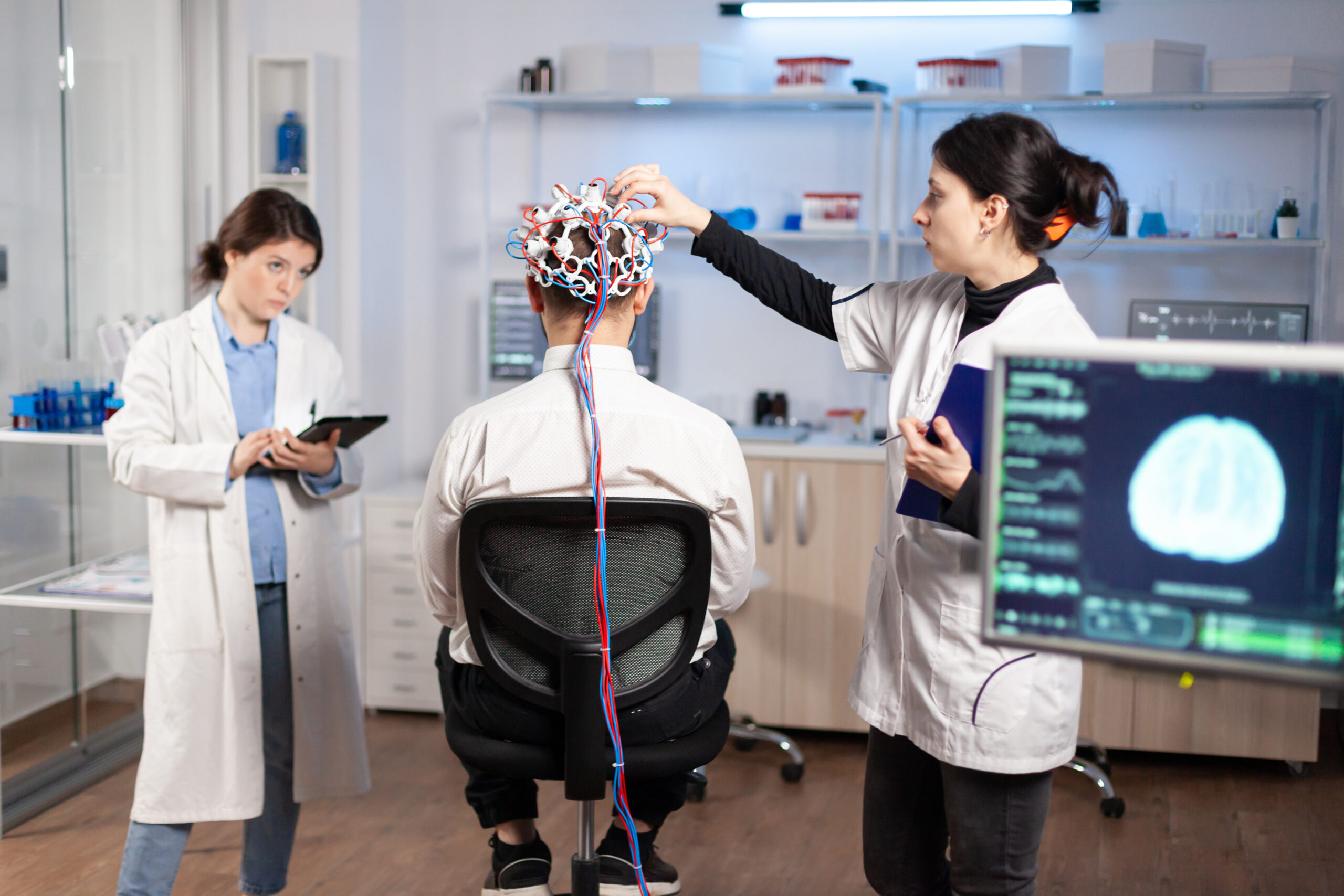
What is the difference between deep TMS and standard TMS?
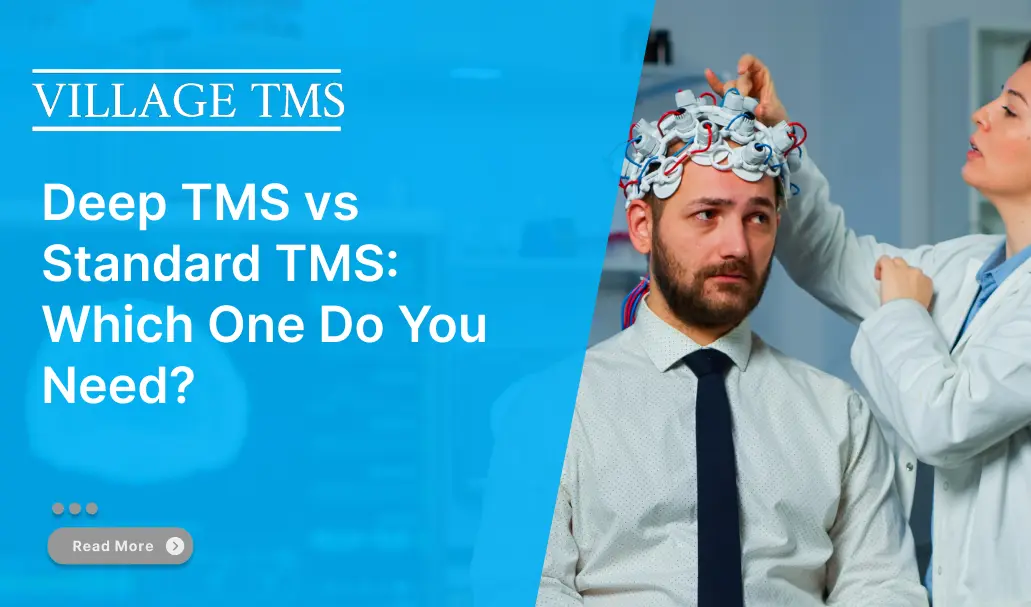
The difference is the coil. Standard TMS uses a figure-8 coil to deliver focused magnetic pulses to the left dorsolateral prefrontal cortex, a surface region involved in mood regulation. The H-coil, built into a helmet, delivers pulses to a larger area and to deeper structures. Both use magnetic pulses and neither needs anesthesia.
| Standard TMS (figure-8 coil) | Deep TMS (H-coil) | |
|---|---|---|
| Depth | About 2 cm below the brain surface | Up to about 6 cm |
| Area stimulated | A focused region near the scalp | A broader, deeper set of circuits |
| Main use | Treatment-resistant depression | Depression, OCD, anxious depression, smoking cessation |
| Coil design | Handheld coil positioned on the scalp | Helmet with multiple windings; different H-coils for different targets |
| Evidence base for depression | Largest and longest | Substantial, with FDA clearance |
| Sensation | Light tapping at the treatment site | Tapping over a larger area, sometimes stronger |
Village TMS currently offers standard TMS with a figure-8 coil, the foundation of treatment for most patients with depression. We do not offer deep TMS at this time. The sections below describe deep TMS for information, including where it has its strongest evidence.
What is each type of TMS FDA-cleared to treat?
Both are FDA-cleared for depression in adults who did not improve on antidepressants. Beyond that, the clearances diverge: the H-coil has additional clearances for OCD, smoking cessation and anxiety symptoms in depression, while standard TMS devices are cleared mainly for major depression, with some devices also cleared for OCD or anxious depression.
- Major depressive disorder: standard rTMS has been cleared since 2008, and deep TMS was cleared later for adults who failed antidepressant treatment
- OCD: deep TMS was cleared in 2018 as an adjunctive treatment after a controlled trial, and other TMS devices have since been cleared for OCD
- Anxious depression: cleared in 2022 for both deep TMS and standard systems, for decreasing anxiety symptoms in adults with major depression
- Smoking cessation: deep TMS is cleared as an aid in short-term smoking cessation for adults
The National Institute of Mental Health lists the conditions TMS is cleared for and notes that in deep TMS two coils may be used to deliver more stimulation to target larger structures deep in the brain. Clearance does not equal insurance coverage, which we cover below.
Is deep TMS more effective than standard TMS?
For depression, there is no definite evidence that deep TMS is more effective than standard TMS. A 2017 network meta-analysis of 81 randomized trials compared TMS modalities and concluded that no definite evidence of superiority could be supported for any particular one, noting that results were imprecise and many trials were small. In that analysis, deep TMS did not separate from sham, a result the authors tied to limited data, while randomized trials and case series of deep TMS reviewed by Cigna have reported significant symptom improvement.
The H-coil has its own supporting data. A meta-analysis of nine open-label H-coil studies in treatment-resistant depression found a response rate of about 60 percent after 20 sessions, with remission rates varying widely across studies. Open-label results are more optimistic than blinded ones, so treat those figures as encouraging rather than proof of an advantage.
Standard TMS figures from clinical trials are roughly 50 to 60 percent response and 30 to 40 percent remission in treatment-resistant depression, which we cover in our TMS success rate article. The honest takeaway is that both can work, and individual response matters more than the coil label.
When is deep TMS the better choice?
The deeper coil is the better choice when the condition is one where it has the strongest evidence and clearance, mainly OCD. In the pivotal OCD trial, 38 percent of patients receiving active deep TMS had a clinically meaningful response compared with 11 percent on sham. Real-world data from 22 clinical sites later reported a response of about 58 percent among patients who completed a course. That study was funded by the device maker and most authors reported financial ties to it, so read it as supportive evidence rather than independent confirmation.
OCD treatment with the H-coil also differs from the depression protocol. Patients typically have a brief, controlled exposure to a personal trigger before stimulation, and the treatment works best alongside exposure and response prevention therapy rather than as a replacement. It is cleared as an adjunctive treatment.
It may also be considered for treatment-resistant anxious depression, where it carries a specific clearance, and for smoking cessation. Clearance is not the same as coverage, though: Cigna, for example, lists smoking cessation among the uses where TMS is not considered proven. If you are weighing medication-based options for OCD instead, our page on ketamine for OCD describes that approach.

When is standard TMS the better choice?
Standard TMS is usually the first choice for depression because it has the longest track record, the largest evidence base and the broadest insurance coverage. It is also the protocol most clinics and insurers build their policies around, as we explain in our guide to TMS and insurance coverage.
Standard TMS may suit you if:
- Your primary diagnosis is major depression and you have not improved on antidepressants
- You want the most thoroughly studied option and the most straightforward insurance approval
- You prefer a lighter, localized sensation under a handheld coil
Shorter theta burst and accelerated schedules are most developed with figure-8 coils. You can read more about them in accelerated TMS and SAINT, and about the session itself in our step-by-step guide to how TMS works.
Are there differences in side effects and safety?
Both treatments cause mostly mild, short-lived side effects. Common ones are discomfort at the treatment site, headache, facial twitching and, with the H-coil, sometimes facial, jaw or tooth pain because the larger coil stimulates nearby nerves and muscles. These usually ease within the first week or two.
Seizure is the rare serious risk for any TMS. A survey of Clinical TMS Society members covering more than half a million sessions found an overall seizure rate of about 0.7 per 1,000 patients, and reported a significantly higher rate for one H-coil device, 5.56 per 1,000 patients, than for the most widely used figure-8 devices, 0.14 per 1,000. The authors called the absolute risk low and urged more prospective research, and the published survey is worth reading in full. A separate analysis of nearly 95,000 H-coil patients reported about 0.6 per 1,000, falling to about 0.2 per 1,000 when safety instructions were followed. Across all of these sources, the risk stays below roughly 1 in 1,000 patients under standard protocols.
These numbers do not agree with one another, which is itself useful information: the risk is small, estimates depend on how it is counted (per patient or per session, and which devices and protocols were included), and following screening rules matters. Our TMS therapy side effects guide lists the risk factors that raise concern, including seizure history, head injury, heavy alcohol use and certain medications.

Is deep TMS covered by insurance?
Often, for depression. Coverage policies are generally built around FDA-cleared devices and the depression criteria, so a cleared deep TMS device used for depression is usually evaluated like standard TMS, while coverage for other indications is narrower. Cigna, for example, covers H-coil treatment for OCD when its criteria are met, which include age 18 or older, failure of two or more medication trials of at least eight weeks each at an adequate dose (or documented intolerance), an adequate course of psychotherapy, and the Y-BOCS scale at the start and end of each course, as laid out in its coverage policy. Medicare’s New York contractor, National Government Services, states in its local coverage policy (L33398) that deep TMS is not considered reasonable and necessary for OCD.
That difference is why you should check coverage for your specific condition and device before starting. For standard TMS, Village TMS is in network with Aetna, BCBS, Cigna, United, Empire BCBS, Oxford and Medicare and verifies coverage for free, and our TMS therapy cost page explains how we estimate your cost.
How long is a session, and how do the schedules compare?
Both treatments are given as a course of daily weekday sessions over several weeks. At Village TMS, standard sessions last about 20 to 30 minutes, and a typical course is about 36 sessions over roughly six weeks. Coverage policies describe initial courses of 30 to 36 treatments for depression, and the deep TMS OCD protocol in the real-world study cited above used 29 sessions over about six weeks.
Session length is not fixed. NIMH notes that a typical rTMS session can last anywhere from 3 to 40 minutes, and shorter theta burst protocols exist for both coil types. Ask which protocol your clinic uses, because it affects both your time commitment and what your insurer will pay.
What does a session with the helmet coil feel like?
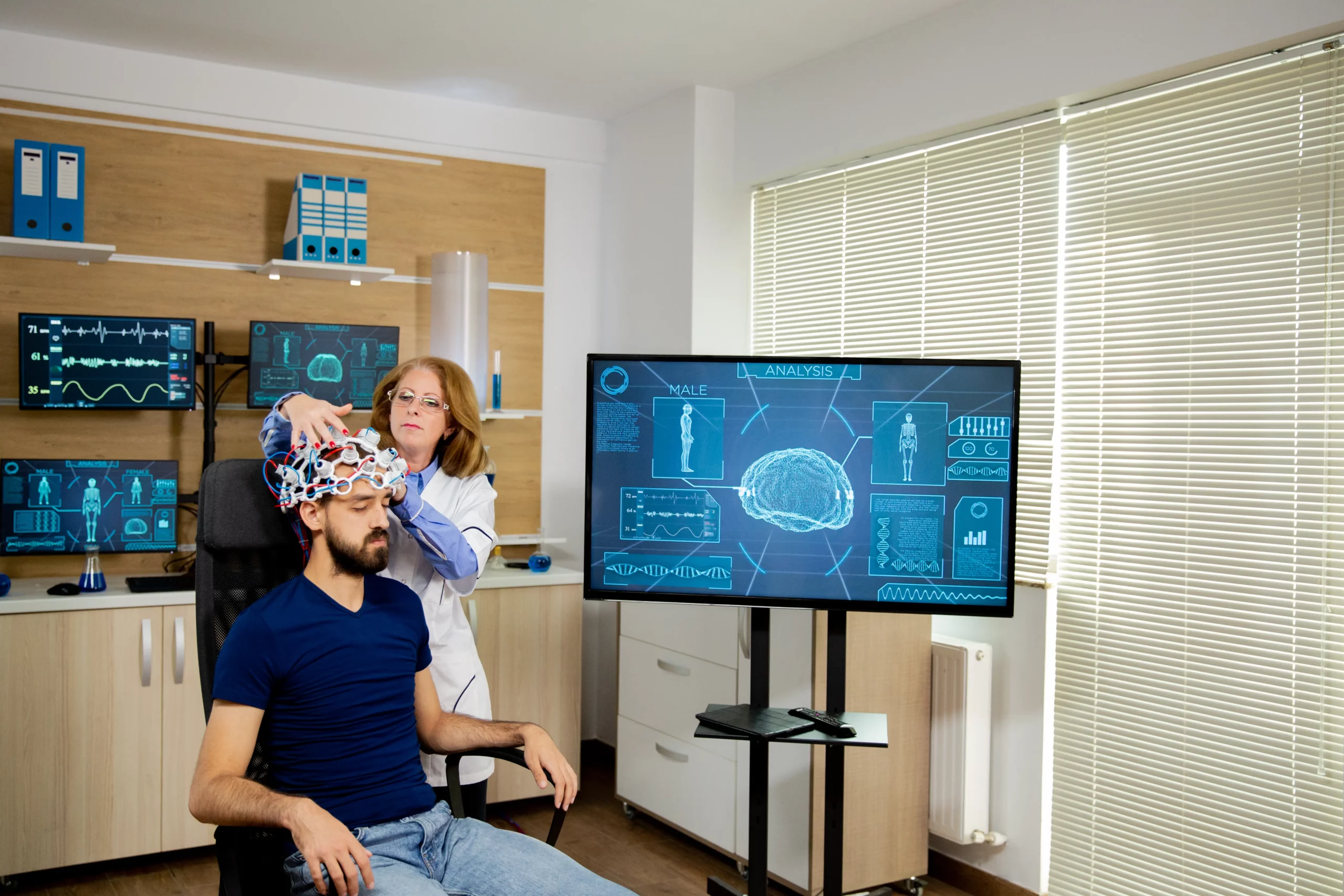
You sit in a reclining chair, fully awake, wearing a helmet that holds the coil against your head, and you feel a knocking or tapping sensation as pulses are delivered. For OCD, the clinician usually brings up a personal trigger for a few minutes before stimulation, which is uncomfortable but controlled and is considered part of why the protocol works. Hearing protection is standard because the coil clicks loudly.
Afterward, you can drive yourself home and return to your day, the same as with a standard session. If the sensation is too strong, your provider can adjust the intensity or coil position, so speak up in the first week rather than waiting it out.
What should you ask a clinic that offers deep TMS?
- Which devices and coils do you use, and for which conditions are they FDA-cleared?
- Why are you recommending this coil for my diagnosis instead of the other one?
- How do you screen for seizure risk and implants before the first session?
- What does my insurance cover for this specific coil and diagnosis?
- What results do you see in patients like me, and how do you measure them?
A trustworthy answer explains the reason for the recommendation and says plainly when standard TMS is the better fit.
How do you decide between deep TMS and standard TMS?
You decide based on your diagnosis, your history and what your plan covers, not on the word deep. A psychiatrist can recommend a protocol after reviewing what you have already tried.
- What is my primary diagnosis, depression, OCD, anxious depression or something else?
- Which medications and therapies have I tried, and how did each go?
- Do I have any seizure risk factors or implants that affect which coil is appropriate?
- What will my insurance cover for each option, and what would I pay?
- Does this clinic offer both, and what outcomes does it track for each?
If your depression is severe or urgent, our comparison of TMS vs ECT explains when a different level of care may be needed, and our treatment-resistant depression page describes the full range of options. You can also find a TMS provider near you.
Call 646-817-2835 or contact us to book a free consultation.